





Copyright and Artificial Intelligence
Contents |
[edit] In brief
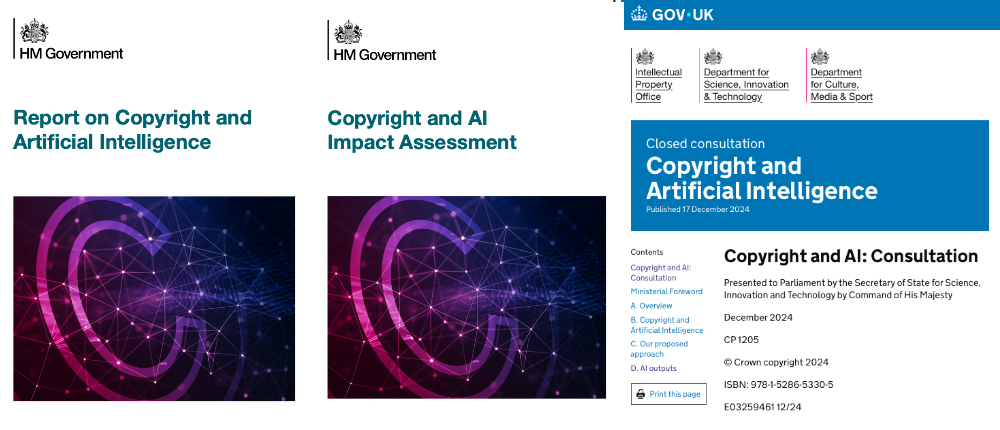
On 18 March 2026, the government Department for Science, Innovation and Technology and the Department for Culture, Media and Sport published its Report on Copyright and Artificial Intelligence, alongside a Copyright and AI Impact Assessment.
These reports are largely the result of earlier government proposals that formed part of a consultation published 17 December 2024. It said to give creative industries and AI developers clarity over copyright laws, which included what it had called an opt-out model. This opt-out model essentially proposed to allow AI developers to opt out in terms of copyright law when concerning AI training, which caused significant outcry from the creative industries, shown in the consultation response with 88% wanting to copyright licenses for all uses.
Alongside this, the Data (Use and Access) Bill, which had been introduced in the UK Parliament on October 23, 2024, received Royal Assent on 19 June 2025, becoming the Data (Use and Access) Act 2025 (DUAA). While the new act does not directly amend existing UK copyright law, it does establish a procedural framework to regulate the intersection of copyright and artificial intelligence (AI). The act is in effect a roadmap for future reform, focusing on data access, training transparency, and licensing rather than on the implementation of immediate broad exceptions for AI and proposals for broad text and data mining (TDM), which were not included.
Some sectors welcomed the legislation as pragmatic, allowing an evolution in the use of AI rather than immediate disruption and reducing administrative burdens to balance economic growth with data protection; others, such as privacy advocates and legal experts, have, though, raised concerns about potential divergence from EU standards.
The most recent report on copyright and artificial intelligence has been seen as general confirmation that the government is backtracking from its previous stance of allowing AIs to opt-out of copyright law for training purposes. As such, the response from creative industries has been positive; it is somewhat hesitant because what the specific alternative to opt-out will be remains unclear. The assessment notes that UK culture is a "world-leading national asset," while at the same time the AI industry is growing "23 times faster than the rest of the economy." The government has said it must take time to "get this right," and Technology Secretary Liz Kendall said, "We have listened," and that the government "no longer has a preferred option."

[edit] Background
At the time of its original consultation in December 2024 the government described its proposals as a balanced package of proposals aimed "to give creators greater control over how their material is used by AI developers, and enhance their ability to be paid for its use" seeking "greater transparency from AI firms over the data used to train AI models alongside how AI-generated content is labelled, but crucially that "AI developers would have wide access to material to train world-leading models in the UK, and legal certainty would boost AI adoption across the economy"
The proposals, in particular the last statement were seen as the government pushing a preference for an opt-out model. The model would see AI companies effectively allowed to use copyrighted works to train models with or without consent and although it mentioned investigations of how remuneration issues might work, they would be largely unremunerated because of the opt-out mechanism. The consultation ran until February 2025 and received a large number of responses, with the large majority opposing the opt-out model, with 88% wanting to see copyright licenses being required for all cases when it came to training AI models on existing works.
The government report positions the creative industries and AI as twin engines of national economic growth and central pillars of its Industrial Strategy, aiming to create high-quality jobs and boost productivity across the UK. It recognises the creative industries’ substantial economic and cultural contribution and the transformative potential of AI, but concludes that current copyright rules around AI training data are unclear and unsatisfactory for both creators and AI firms, driving model training overseas.
In response, it proposes a package of measures, greater transparency obligations on AI developers, a new text and data mining exception that allows right holders to reserve their rights, and a clearer, interoperable legal framework, to strengthen right holders’ control and remuneration, improve lawful access to high-quality training data, rebuild trust, and incentivise leading AI development to take place in the UK. The consultation covered a number of topics including:
- Transparency: Success of new copyright-AI approach relies on trust via transparency on model training data use, with views sought on proportionate requirements.
- Technical Standards :Existing right-reservation tools need improvement in standardisation and adoption for all sizes of right holders and AI developers.
- Contracts and Licensing: Licensing, including collective models, is key for remuneration and access to high-quality data; views sought on government support for creators.
- Labelling: Clear labelling of AI outputs benefits right holders and public, despite technical challenges; input needed on tools and standards.
- Computer Generated Works: UK protects computer-generated works but usage and fit in copyright framework are unclear; reform options under consideration.
- Digital Replicas: Rising AI-generated deepfakes replicating likeness raise control issues; evidence sought on legal gaps and interventions needed.
- Emerging Issues: Fast AI advances prompt questions on IP for search-generated content, synthetic data, and inference datasets.
- Next Steps: Government will collaborate urgently with stakeholders, likely via legislation, using responses to grow creative and AI sectors together.
[edit] Report on Copyright and Artificial Intelligence
The report on Copyright and Artificial Intelligence is mandated by and themes are aligned with the UK’s Data (Use and Access) Act 2025 (D(UA) on AI development following the December 2024–February 2025 government consultation which received 11,500+ responses. It evaluates the regulatory environment and policy options in the crossover between Copyright and AI training, and also considers computer-generated works and digital replicas, which were part of the consultation but are not included in D(UA), an accompanying economic impact assessment report was also published.
Detail consideration is given to the effect of copyright on access to, and use of, data by AI developers, transparency around the theme, the outputs of AI systems, technical measures and standards of control, access and use, restrictions, licensing, enforcement, and deeper analysis of the above relating to computer-generated works, and digital replicas.
The report covers copyright in detail, looking at the status quo, current law and its application in the uk and internationally, types of protection, rights and exceptions in terms of copyright and types of artificial intelligence models. The potential for a broad data mining exception, allowing right holders to reserve rights by opting out, the exceptions with opt-outs and potential effects, the possibility of no new exceptions, strengthening copyright so that licensing is required for AI development, a broad data mining exception, but no opt-out a swell as alternative approaches.
It looks at transparency around inputs and outputs of models, including web crawler transparency, legislative and International approaches, the consultation itself, technical working groups, with conclusions and proposals. The challenges surrounding technical tools and standards as well as the legal basis for copyright licensing, and the current licensing environment for AI. It looks also at existing enforcement mechanisms, the role of a regulator, market access and extra-territoriality, drawing from the results of consultation, with concluding points and proposals.
Finally the report looks more closely at issues not covered by D(UA) such as computer-generated works and digital replicas. The rationale for protection of computer-generated works, forms of copyright protection for AI outputs, and the legal scope of protection. It details the impacts in the use of digital replicas, applications of existing UK law and intellectual property law, as well as the commercial and creative impact of digital replicas. It uses examples from International law and general developments that relate to both themes. Finally reviewing the consultation responses, and ongoing stakeholder engagement, drawing its conclusions and making a set of proposals.
[edit] Conclusions and proposals
In terms of input transparency the report advocates proportionate, industry-led transparency standards for AI developers to disclose training data and content usage, aiding copyright compliance and right holders' enforcement without overburdening SMEs. It notes creative industries' strong support for mandates versus tech firms' preference for high-level voluntary approaches, proposing ongoing monitoring of EU-style rules while developing best practices with diverse stakeholders, including foreign developers, to balance enforcement clarity and AI innovation. The report welcomes stakeholder collaboration on output transparency and proposes industry-led efforts to establish good practices for labelling AI-generated content, aiming to build consumer confidence and public trust. It also commits to monitoring international developments for compatibility and partnering globally to develop aligned standards and solutions.
The government welcomes the rapid progress in terms of technical tools and standards for right holders to enforce rights, manage permissions, and enable AI training licensing that has developed since the consultation. It proposes supporting market-led innovation through industry collaboration on best practices, covering principles for standards, web crawler use, transparency, output labelling, and SME-friendly adoption—while monitoring international approaches and reserving regulation if needed to avoid disproportionate burdens.
In terms of AI licensing it proposes no immediate market intervention due to insufficient evidence but recognises the growing value of creative materials. Instead of intervention it will rely on forthcoming best practices for transparency and technical tools to boost current licensing while monitoring the effects on SMEs, individuals, and the evolving market. This includes looking toward foreign AI systems, global trends, litigation on secondary liability, and public datasets via the Creative Content Exchange pilot launching summer 2026. The Department for Education will advance AI use in schools to enhance teaching, protect pupil IP rights, and reinvest licensing funds into education.
The report deems the current copyright enforcement framework effective and adaptable to AI but proposes further collaboration with sectors, law enforcement, and judiciary to enhance proportionate access to redress for infringements involving UK and foreign AI systems, considering the impact on individuals and SMEs. It plans an evaluation of enforcement for copyright use in AI training, barrier mitigation actions, but no new regulators or duties on existing ones, as well as the monitoring of international approaches like the EU, to assess effects on AI development and right holder remedies.
The report finds scant evidence of usage or economic benefit from copyright protection for computer-generated works (CGWs), stating that most of the consultation respondents, including those from creative industries and limited AI voices favour its removal to prioritise incentives for human creativity. The government proposes monitoring but ultimately repealing this protection in the absence of proof of its value. However in terms of AI-facilitated digital replicas of for example voices and faces, it sees that there is an offer of creative potential but that it also poses significant risks of harm. In particular from unauthorised use, and illegal content when carried out without permission. It notes that the creative industries, in particular performers see the current protections as being inadequate. The consultation responses highlighted gaps in the framework, in terms of passing off works, copyright, performers' rights, and non-IP laws like privacy, but there is a general lack of consensus on possible solutions. The government proposes exploring a number of tailored options, potentially including new personality rights, to mitigate risks while at the same time fostering innovation.
[edit] Copyright and AI Impact Assessment report
The Impact Assessment under the Data (Use and Access) Act 2025 evaluates four policy options from the 2024-2025 Copyright and AI consultation: doing nothing, strengthening copyright, a broad text-and-data mining (TDM) exception, or a TDM exception with rights reservation mechanism.
It underscores AI's transformative economic promise, potentially adding £55-140 billion to UK GVA by 2030 via productivity gains, while highlighting creative industries' £146 billion contribution (nearly 6% of total GVA in 2024), including a £62 billion IT/AI sub-sector growing twice as fast as the wider economy.
The sectors are interdependent: creative content trains superior AI models, while AI boosts creators' workflows; however, current copyright laws constrain UK-based AI training, limit right holders' control and remuneration, and hinder broader AI adoption.
Under "do nothing," licensing markets may expand but UK competitiveness lags; strengthening copyright could boost creator earnings but deter foreign AI entry; a broad exception favours AI growth at potential cost to creative investment; rights-reservable TDM offers balance but hinges on mechanism effectiveness and adoption.
No reforms will advance without robust evidence of net benefits; the government prioritises monitoring licensing trends, international rules, case law, and technical standards, alongside commissioned research on AI adoption and creative-AI interactions to inform future, fully assessed legislation.
[edit] Related articles on Designing Buildings
- Digital quality management in construction
- The influence of digital technologies on conservation
- Architectural Technology and AI
- AI and the challenges to intellectual property
- Shortage of high-quality data and other fundamental issues threatening the AI boom
- AI is killing the goose that laid the golden egg
- UK consults on proposals to give creative industries and AI developers clarity over copyright laws
Featured articles
Check out some of the best features and news from Designing Buildings as well as key stories from around the web.

CIOB publishes free template to help assess and manage risks.
ECA's reflections on Party Conference season

Burnham wants to be confident of winning before asking for a fresh mandate.
New Chief Construction and Scientific Adviser

Sergio Cavalaro, Professor of Infrastructure Systems at Loughborough University.
Building safety levy for England

CIAT publish estimator tool for members.

Water sector faces a growing crisis that could slow the delivery of vital infrastructure.
Undervaluing our industrial past

Heritage value changes as taste for building styles changes.
Changing expectations around competence and compliance

New information sheet from CIAT.
Grenfell investigation files passed to CPS

Angela Rayner apologises on behalf of the British state.

Electrical contractors need to understand the practical implications.

The real barrier to getting more value from digital technology.

Your guide to The Construction Reset at UKCW Birmingham.

Accommodating the Victorian and Edwardian working woman. Book review.